In the pursuit of health and safety today, water treatment systems (or water purification equipment) have become standard in both household and industrial settings. Facing a wide array of technologies on the market, are you confused about Ultrafiltration (UF) and Reverse Osmosis (RO), these two mainstream technologies? They are both powerful membrane separation technologies, but their operating principles and final permeate quality are significantly different.
The wrong selection can lead to a wasted capital investment or, worse, fail to resolve your core water quality challenges. This article will provide an in-depth analysis of the advantages and characteristics of Ultrafiltration from a professional perspective, compare it with Reverse Osmosis, and help you determine the most appropriate water purification solution for your specific needs.
Core Technology Analysis: What is Ultrafiltration (UF)?
Understanding Ultrafiltration: The Undisputed “Water Purification Expert”
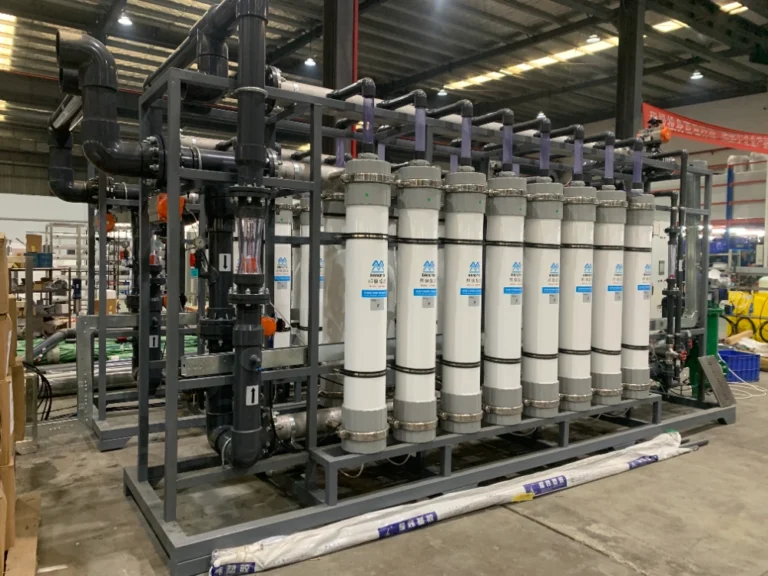
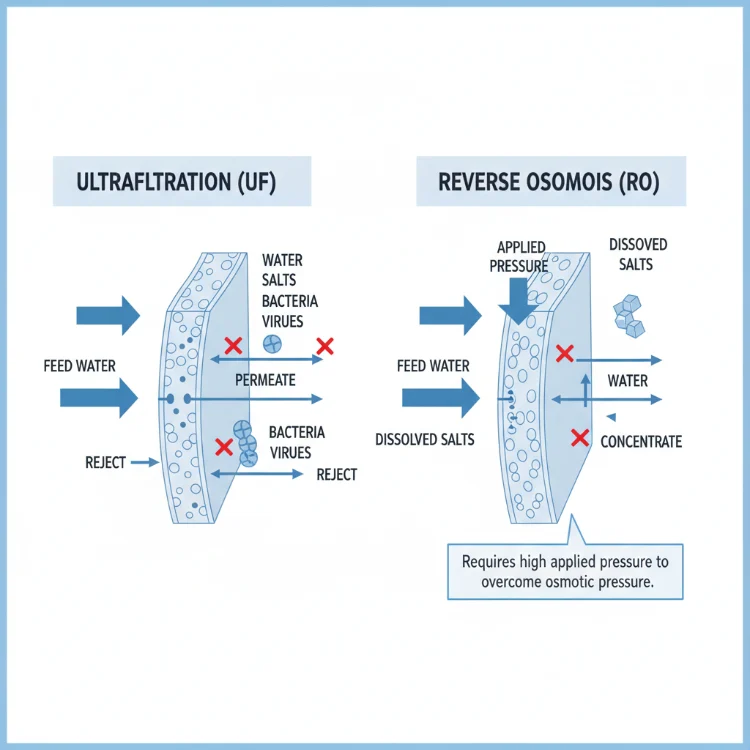
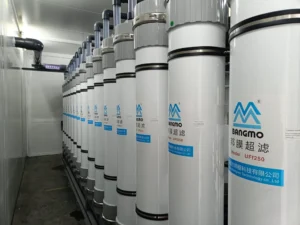
Ultrafiltration utilizes membrane pore sizes from micron to nanometer level (typically $0.01$ micrometers) and employs water pressure drive for high-efficiency filtration.
Core Advantages and Characteristics of Ultrafiltration
- High Separation Precision (0.01 μm): This precision is sufficient to effectively remove particulate matter, colloids, rust, suspended solids, bacteria, viruses, and macromolecular organic substances from the water.
- Retention of Beneficial Minerals: This is one of UF’s greatest advantages. Since soluble inorganic salts (minerals) like calcium, magnesium, potassium, and sodium exist as ions, their diameter is much smaller than the UF membrane pores, allowing them to pass through easily. For users seeking “healthy live water” and better taste, Ultrafiltration is the ideal choice
- High Flow Rate and Low Energy Consumption: UF equipment typically has a fast water output speed, meeting the high-volume demand for whole-house purification or even small-to-medium industrial use.Furthermore, it does not require a high-pressure booster pump, resulting in extremely low operating energy consumption.
- Zero/Minimal Wastewater Generation: Unlike RO, UF is a concentration/separation process rather than a purification process. In normal operation, it generates virtually no wastewater (only a small discharge during membrane flushing), making it highly environmentally friendly and water-saving.
If your municipal water quality is fundamentally good, and you only need to remove bacteria and improve taste while retaining natural minerals, then the cost-effective Ultrafiltration system is your preferred solution
Comparative Technology Analysis: What is Reverse Osmosis (RO)?
Understanding Reverse Osmosis
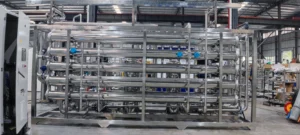
Reverse Osmosis is dubbed the “Pure Water Creator.” The RO membrane pore size is only $0.0001$ micrometers, theoretically allowing only water molecules to pass through
Characteristics of Reverse Osmosis
- Ultimate Water Purity: It removes almost all impurities, including bacteria, viruses, organic matter, and the impurities UF cannot remove, such as Total Dissolved Solids (TDS) and heavy metal ions. The permeate water approaches pure water.
- Mandatory Wastewater Generation: To prevent membrane fouling, the RO system must discharge high-concentration impurities as wastewater (concentrate). This results in a fixed concentrate-to-permeate ratio (wastewater ratio), leading to some degree of water resource waste.
- Mandatory Pressurization and Energy Consumption: To overcome osmotic pressure, the RO system must be equipped with a high-pressure booster pump, resulting in relatively higher energy consumption.
Ultrafiltration vs. Reverse Osmosis: How Should I Choose?
- Core Function
Ultrafiltration (UF) [Live Water Retaining Minerals]: The primary function is the removal of bacteria, viruses, colloids, and macromolecular organic substances from the water.
Reverse Osmosis (RO) [Ultimate Pure Water]: The core function is the removal of almost all impurities, including Total Dissolved Solids (TDS) and heavy metals.
- Retention of Minerals
Ultrafiltration (UF): Yes.
Reverse Osmosis (RO): No; the product water quality (permeate) approaches pure water.
- Wastewater Generation
Ultrafiltration (UF): Generates minimal or virtually no wastewater.
Reverse Osmosis (RO): Yes; it requires the discharge of concentrated impurities (concentrate).
- Permeate Flow Rate
Ultrafiltration (UF): The permeate flow rate is fast, suitable for whole-house or high-volume applications.
Reverse Osmosis (RO): The permeate flow rate is slower, typically requiring a storage tank.
- Energy Requirement
Ultrafiltration (UF): The energy requirement is low.
Reverse Osmosis (RO): The energy requirement is higher because it requires a booster pump.
Scenario Application Analysis: Matching Solutions to Needs
When to Choose Ultrafiltration (UF)
Pursuing healthy drinking water: You value the nutritional content of water and wish to retain natural minerals
- Whole-house purification needs: You require a high-flow-rate water treatment solution for initial purification of domestic water, such as for showering and laundry
- Good municipal water quality: The source water TDS is within the normal range, and the focus is on removing microbiological contamination and particulate matter
- Focus on environmental protection and water saving: You have strict requirements or specific concerns about wastewater discharge
When to Choose Reverse Osmosis (RO)
- Severe source water contamination: The source water TDS value is very high, or there are clear problems with heavy metals or inorganic salt exceedances
- Strict industrial/experimental requirements: You require ultra-high standards of pure water or ultrapure water
- Extreme taste requirements: You pursue the ultimate pure “water” taste
Conclusion and Recommendation
The choice of water treatment is not “black and white”; there is no absolute good or bad, only the one that best suits your water quality and needs.
If you are still struggling to decide between the Ultrafiltration system, which retains natural nutrients, offers high flow, and has low energy consumption, or the Reverse Osmosis system, which provides ultimate purity by removing all impurities, we recommend starting with a professional water quality report.