In cGMP-regulated industries such as biopharmaceutical manufacturing, parenteral drug formulation, and sterile medical device packaging, steam is classified not just by its thermal energy, but by its microbiological and chemical purity. Operating a sterile facility requires absolute control over fluid utilities.
This guide provides an engineering breakdown of Pure Steam Generators (PSGs), expanding on their core definitions, regulatory steam grade distinctions, and the internal thermodynamic mechanics that guarantee pyrogen-free vapor output.
1. What is a Pure Steam Generator (PSG)?
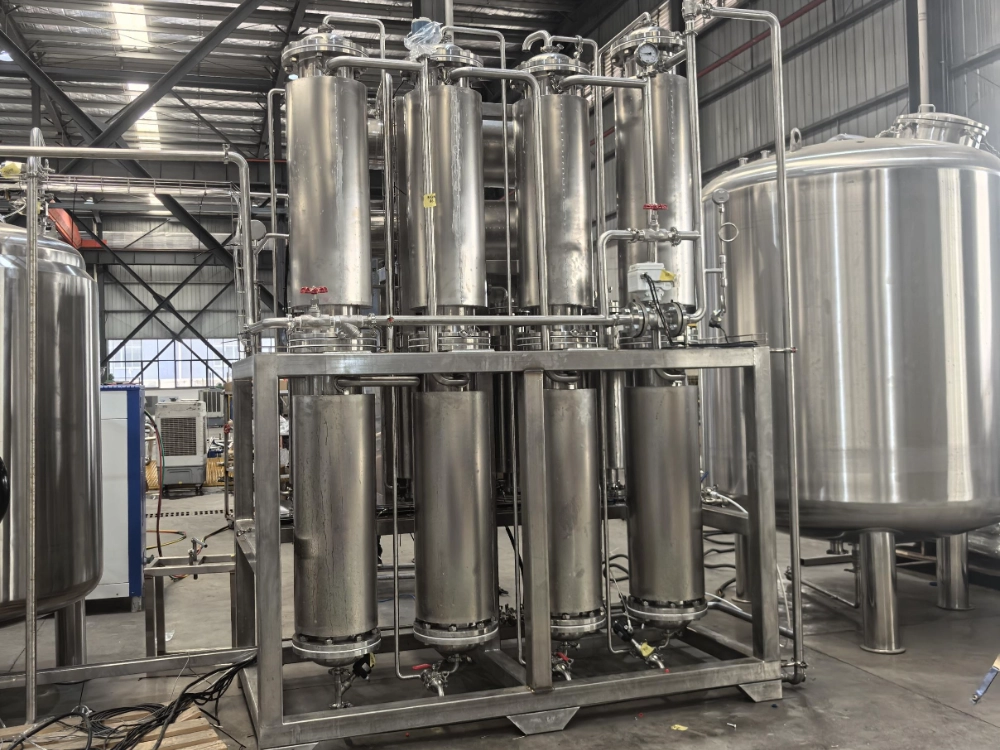
A Generador de vapor puro (PSG) is a specialized, sanitary-grade thermal engineering system designed to convert purified feed water into sterile, dry, and pyrogen-free vapor.
Unlike standard industrial boilers that prioritize thermal capacity, the primary objective of a PSG is contaminant exclusion. It is engineered to volatilize separate pure water molecules from non-volatile impurities, including:
-
Bacterial endotoxins and pyrogens (lipopolysaccharides from bacterial cell walls).
-
Dissolved inorganic ions (silica, calcium, heavy metals).
-
Microbial bioburden and particulate matter.
The Regulatory Standard
To comply with global regulatory bodies—including the United States Pharmacopeia (USP), European Pharmacopoeia (Ph. Eur.), and cGMP guidelines—the condensed output of a PSG must strictly match the chemical and microbiological specifications of Agua para preparaciones inyectables (WFI). This means it must consistently maintain an endotoxin load of $< 0.25$ EU/mL and an electrical conductivity of $\le 1.3$ $\mu$S/cm at 25°C.
2. Structural Distinctions: Industrial vs. Clean vs. Pure Steam
Misspecifying steam grades within a facility can lead to regulatory validation failure, batch rejections, or irreversible piping damage due to pitting and stress corrosion cracking (SCC). The table below establishes the technical boundaries between the three primary steam utility grades:
| Technical Dimension | Industrial Steam (Plant Utility) | Clean Steam | Pure Steam (PSG Output) |
| Feed Water Input | Softened water (calcium/magnesium removed via ion exchange) | Single-stage Reverse Osmosis (RO) or Deionized (DI) water | Double-stage RO water or distilled Water for Injection (WFI) |
| Material of Construction (MOC) | Carbon Steel / Low-grade Cast Iron | AISI 304 or 316 Stainless Steel | AISI 316L Stainless Steel (with electro-polishing to $Ra < 0.4 \mu m$) |
| Volatile Additives | Contains neutralizing amines and film-forming corrosion inhibitors | Free of boiler chemicals; may contain ambient dissolved gases | Zero additives allowed. Completely chemical-free and pyrogen-free. |
| Condensate Purity Standard | Contains boiler carryover (iron oxides, silica, chemical treatment residues) | Free of visible particulate matter; no certified microbial or pyrogen removal | Strictly matches WFI specifications ($<0.25$ EU/mL endotoxins, Conductivity $\le 1.3$ $\mu$S/cm) |
| Primary Applications | Non-product contact jacket heating, CIP solution heating | Non-sterile product contact, cleanroom HVAC humidification | SIP (Sterilization-in-Place) of bioreactors, autoclave supply, aseptic filling line sterilization |
3. How Does a Pure Steam Generator Work? The Mechanics of Contaminant Exclusion
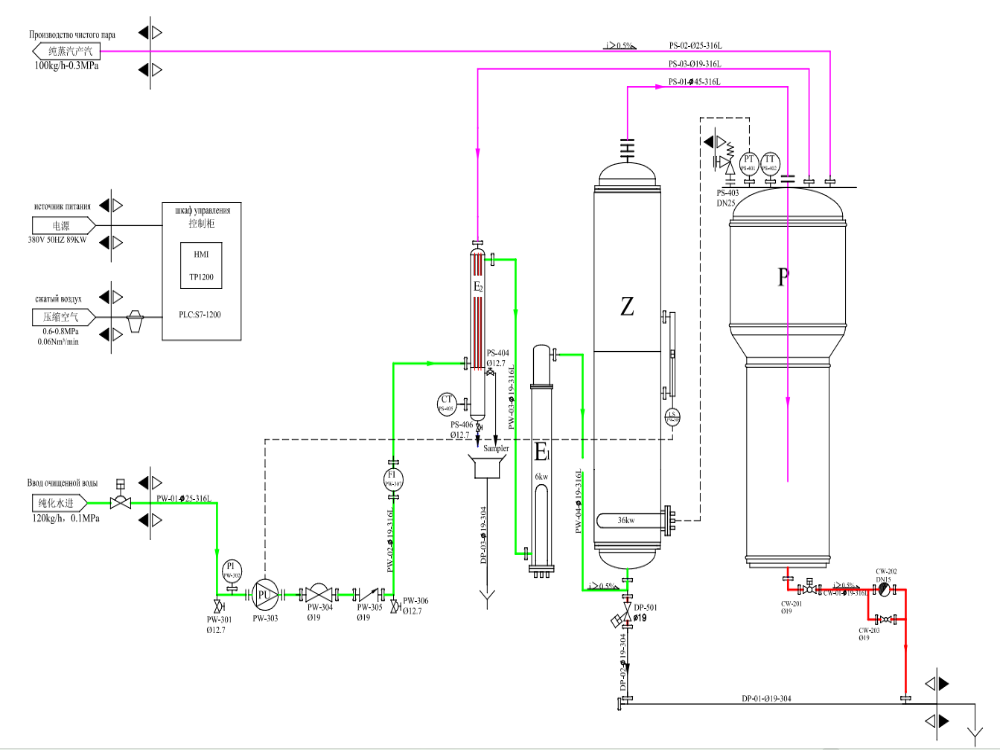
To achieve WFI-grade purity without using chemical filters, modern industrial PSGs rely on a continuous thermodynamic separation process. The most thermally efficient design utilized in the pharmaceutical industry is the vertical falling-film evaporator paired with a multi-stage physical separation column.
Here is the chronological, step-by-step engineering sequence of how a PSG processes feed water into pure steam:
[Feed Water Influx] ──> [Dual-Stage Preheaters (85–95°C)] ──> [Top Distribution Plate]
                                                                        │
[Pure Steam Out] <── [3-Stage Separation] <── [Falling-Film Flash] <────┘
Phase 1: Pressurization, Filtration, and Micro-Preheating
-
Hydrodynamic Influx: Qualified double-stage RO water enters the system and is immediately pressurized by a multi-stage sanitary pump to a constant pressure of 0.3 to 0.5 MPa. Constant pressure is vital to maintain a non-fluctuating fluid dynamics profile inside the heating zones.
-
Particulate Safeguard: The pressurized water passes through a 0.22 $\mu$m hydrophobic cartridge filter to catch any lingering micro-colloids, protecting the downstream evaporator walls from localized fouling.
-
Thermal Reclamation: Before entering the main boiling chamber, the water routes through a dual-stage heat recovery skid (preheaters). These exchangers capture the latent heat from the outgoing pure steam and the industrial plant steam condensate, elevating the feed water temperature to 85–95°C. This minimizes the subsequent thermal load on the evaporator and prevents thermal shock within the column.
Phase 2: Falling-Film Evaporation (The Vaporization Flash)
The preheated water reaches the absolute top chamber of the vertical shell-and-tube evaporator column.
-
Film Distribution: The water passes through a high-precision distribution plate that forces the liquid to flow downward along the inner walls of the AISI 316L tubes, creating a uniform, continuous liquid film measuring just 0.5 mm to 1.0 mm in thickness.
-
The Thermal Exchange: High-pressure industrial plant steam (the primary heating utility, running at 0.6 to 0.8 MPa and 130–140°C) is fed into the shell side (the exterior space surrounding the tube bundle). Heat conducts rapidly through the thin tube walls, causing the falling internal water film to flash into secondary pure steam instantly at 105–110°C.
-
Prevention of Droplet Projection: Because the water film is exceptionally thin and moving rapidly downward under gravity, it vaporizes smoothly. This eliminates “nucleate pooling” (the aggressive, explosive bubbling found in old kettle-type boilers), minimizing the initial projection of raw liquid droplets into the rising vapor stream.
Phase 3: Progressive Three-Stage Separation (Pyrogen Stripping)
As the mixture of flashed pure steam and unvaporized water exits the bottom of the tube bundle, it enters the lower separation chamber. Because heavy-molecular-weight endotoxins and pyrogens are non-volatile, they cannot turn into a gas; they can only bypass the system by riding on microscopic moisture mist. The PSG strips these droplets via three consecutive physical mechanisms:
-
Stage 1: Gravity Sedimentation: The sudden expansion of space as the vapor enters the wider separation chamber causes an immediate drop in velocity. Heavy liquid droplets ($>10 \mu m$) lose kinetic energy and drop directly to the bottom of the column, where they are continuously discharged via an automated blowdown valve (maintaining a 3% to 10% blowdown rate to prevent impurity concentration).
-
Stage 2: Cyclonic Centrifugal Separation: The ascending vapor is forced through fixed internal helical guide vanes, spinning the steam at high velocity. The resulting centrifugal acceleration drives intermediate-sized mist (5 to 10 $\mu$m) outward against the interior walls of the chamber, where the liquid coalesces and drains down.
-
Stage 3: High-Density Wire-Mesh Demister: The final polishing phase forces the dry vapor through a tortuous path inside a dense, multi-layered mesh of AISI 316L wires. Residual micro-droplets ($<5 \mu m$) impact the metal filaments, aggregate into larger droplets via surface tension, and fall backward against the vapor flow.
Phase 4: Validated Discharging and Automated Quality Diversion
The pure, completely dry vapor (achieving a steam dryness fraction $\ge$ 99.5% and a non-condensable gas content $<3.5\%$ V/V per EN 285) exits the top discharge nozzle at $\ge$ 121°C into the facility distribution loop.
If the system’s in-line digital conductivity transmitter detects an unexpected purity anomaly (condensate conductivity spiking above 1.3 $\mu$S/cm at 25°C), the central PLC instantly closes the distribution valve and opens a pneumatic dump valve, diverting the unvalidated steam to the drain until feed conditions stabilize.