In high-tech manufacturing, precision electronics, and pharmaceutical processing, water is never just water. Standard tap water is packed with dissolved minerals, calcium, sodium, and chlorides. While harmless to humans, these microscopic ions cause catastrophic short circuits on microchips and corrupt chemical formulas.
This is where DI water (Deionized Water) becomes an operational necessity. For global engineering managers, understanding how deionization works, its key metrics, and how it pairs with an industrial reverse osmosis system is critical to achieving uninterrupted facility uptime.
This ultimate B2B guide breaks down everything you need to know about DI water, its production technology, and how to source the right purification architecture for your plant.
🔬 What is DI Water? The Chemical Definition
DI water, short for Deionized Water, is water that has had almost all of its mineral ions removed. This includes cations like sodium (Na+), calcium (Ca2+), iron (Fe3+), and copper (Cu2+), as well as anions such as chloride (Cl-), sulfate (SO42-), and nitrates.
The primary yardstick for DI water quality is Electrical Resistivity (measured in Megohm-cm, MΩ-cm) or Electrical Conductivity (measured in MicroSiemens/cm, µS/cm).
- Theoretical completely pure water has a resistivity of 18.2 MΩ-cm at 25°C.
- The higher the resistivity, the fewer mineral ions remain in the stream, making the water highly non-conductive and chemically hungry.
📊 Technical Comparison: DI Water vs. RO Water vs. Distilled Water
Procurement teams frequently confuse DI water with other ultra-pure water variants. They are not interchangeable. Here is the technical breakdown:
| Water Type | Primary Production Method | Target Impurities Removed | Typical Resistivity Range |
|---|---|---|---|
| RO Water | Physical Membrane Separation | 95-99% of All Minerals, Organics & Bacteria | 0.05 to 0.2 MΩ-cm |
| DI Water | Ion Exchange Resins / EDI Module | 99.99% of Dissolved Charged Mineral Ions | 1.0 to 18.2 MΩ-cm |
| Distilled Water | Thermal Evaporation & Condensation | Heavy Metals, Non-Volatile Compounds | 0.5 to 3.0 MΩ-cm |
⚙️ How DI Water is Made: Technical Process Paths
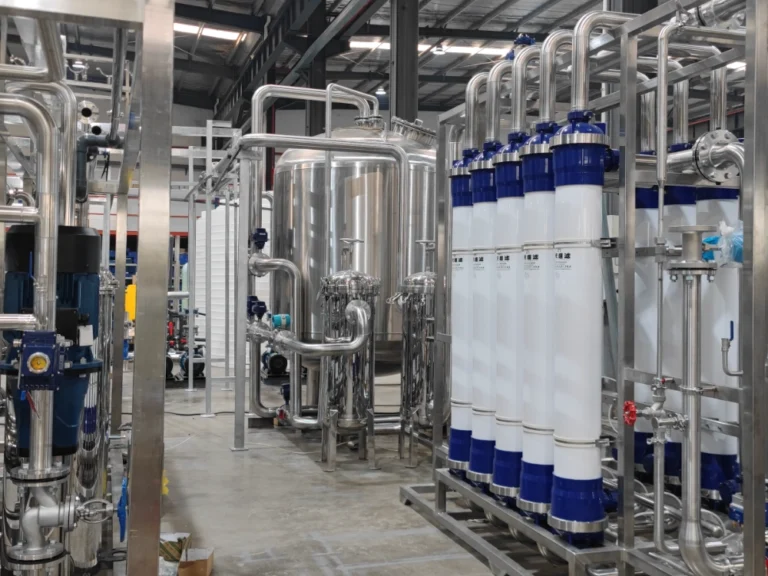
Producing industrial-grade DI water requires a multi-stage approach. Raw water must always pass through a pre-treatment block (typically an industrial reverse osmosis system) before entering the polishing stage. Sourcing DI water without RO pre-treatment will exhaust your ion exchange resins within days.
Path A: Traditional Ion Exchange Resins (DI Vessels)
Water passes through synthetic polymer beads packed into pressurized tank housings.
- Cation Resins swap metallic minerals (like calcium) for Hydrogen ions (H+).
- Anion Resins swap non-metallic minerals (like silica) for Hydroxyl ions (OH-).
- When mixed together in a single vessel (Mixed Bed DI), they deliver exceptional purity up to 18 MΩ-cm. However, once saturated, they require aggressive chemical regeneration using hydrochloric acid and caustic soda.
Path B: Modern Continuous Electrodeionization (EDI Systems)
The premium alternative favored by modern high-tech factories is EDI (Electrodeionization). EDI combines ion-exchange membranes, resin beads, and a DC electrical current to continuously flush minerals out of the stream.
- The Core Edge: EDI self-regenerates continuously under the electrical field. It requires zero chemical downtime, zero acid/alkali handling, and provides a continuous, unvarying flow of high-resistivity water.
🏭 Critical Applications: Who Demands Deionized Water?
Semiconductors & Electronics
18.2 MΩ-cm Ultra-PureIn microchip fabrication, even a single copper ion can bridge microscopic circuit gaps and destroy an entire wafer. Ultra-pure DI water is utilized to continuously wash silicon wafers during photolithography steps.
Pharmaceuticals & Biotech
USP Standards complianceDI water serves as the baseline compound for batch liquid products, laboratory reagent setups, and autoclave sterilization loops, ensuring zero chemical cross-contamination.
Heavy Boiler & Turbine Utilities
Scale Prevention LoopHigh-pressure power plant boilers operate at immense temperatures. Using mineralized water creates instant scale formation, reducing heat transfer and causing tube failures. High-volume brackish water RO skids paired with DI units mitigate this risk completely.
💎 Sourcing Your DI Water Plant: The Moerwater Advantage
Sourcing an industrial DI water setup requires absolute mechanical integrity. Because DI water is starved of ions, it is highly corrosive to standard metals—it will actively leach iron out of generic stainless steel pipes.
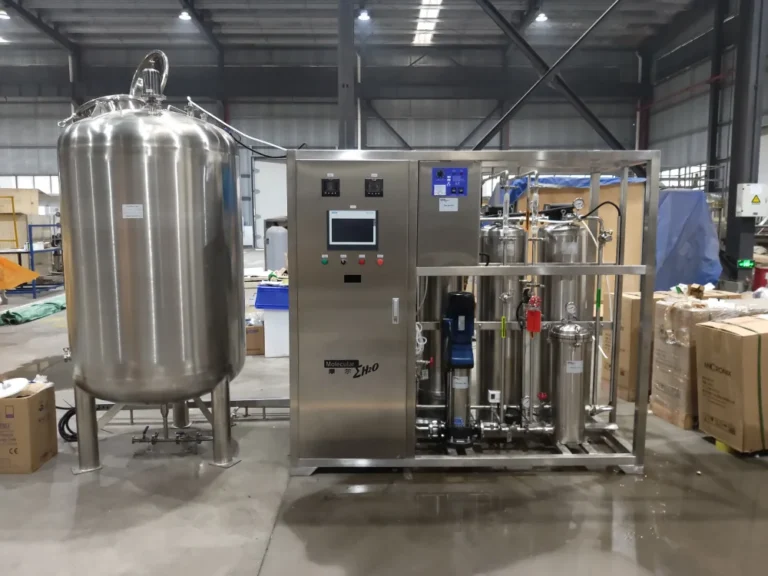
Moerwater engineers custom, turnkey DI water systems utilizing advanced double-pass RO configurations paired with premium EDI blocks. We eliminate engineering risks through robust design standards:
- High-Standard Material Selection: We utilize premium high-purity PVDF or orbitally welded SS316L piping on all ultra-pure DI lines to guarantee zero leaching or particle sheds.
- True Continuous Performance: Our automated EDI configurations maintain steady 15+ MΩ-cm resistivity streams without requiring chemical regeneration outages.
- Zero-Substitution Transparency: Every skid features authenticated global components—including premium DuPont membrane segments and Siemens PLC logic boards—fully wet-tested before shipping.
Engineered DI Water Solutions for Your Facility
Don’t risk scaling or product defects. Contact Moerwater’s fluid application engineers today to receive a complete 3D CAD system proposal matching your water analysis profile.
Consult a DI Water Engineer Now