Introduction : Le Ultime Réponse aux coûts élevés du traitement de l'eau
Dans la production de Eau ultra-pure (UPW), la gestion des coûts constitue l'une des le plus important Les systèmes d'échange d'ions à lit mélangé (MB-IX) ont dominé l'étape finale de la purification. Pendant des décennies, les systèmes conventionnels d'échange d'ions en lit mixte (MB-IX) ont dominé l'étape finale de la purification. Cependant, les systèmes d'échange d'ions à lit mélangé le point le plus douloureux des systèmes IX est la dépendance à l'égard d'une régénération chimique, ce qui entraîne des coûts élevés liés à l'approvisionnement en produits chimiques, au stockage, à l'élimination et, surtout, à l'indisponibilité inévitable du système.
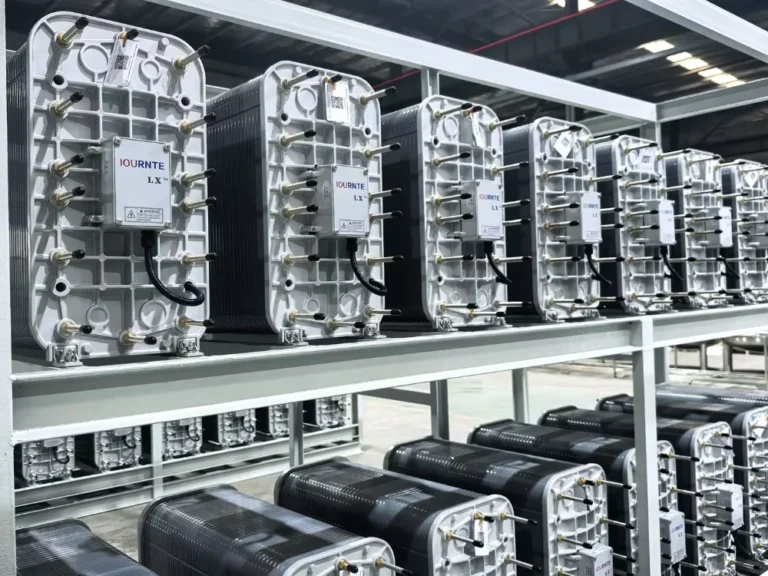
Cet article révèle les percée solution de Électrodéionisation (EDI) technologie. EDI est le ultime solution intégrant parfaitement des résines échangeuses d'ions, des membranes sélectives d'ions et un champ électrique continu pour obtenir une élimination continue des ions sans la régénération chimique. Cela permet de béguin les coûts récurrents associés aux processus de régénération traditionnels.
Nous explorerons 7 secrets ultimes sur la façon d'accélérer et de efficacement éliminer jusqu'à 70% de vos dépenses de fonctionnement en déployant ou en optimisant un système d'information. EDI système.
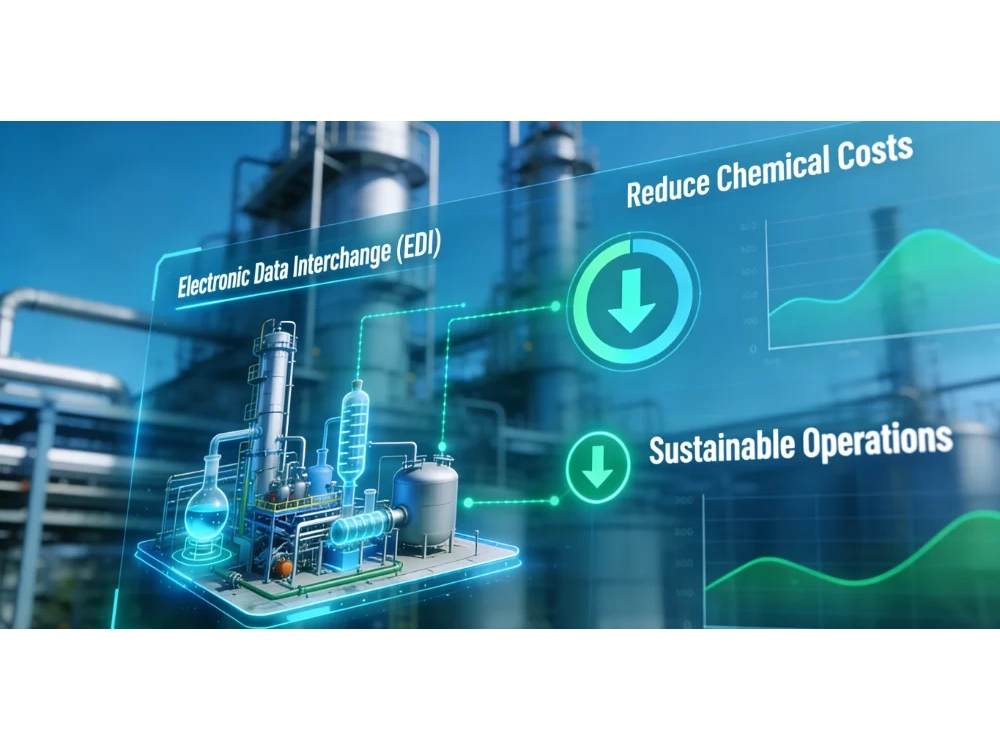
1. Béguin Coûts des produits chimiques avec le développement durable EDI Fonctionnement
Les résines IX traditionnelles nécessitent une régénération périodique à l'aide de produits chimiques agressifs tels que les acides forts (HCl) et les bases fortes (NaOH). Il en résulte un double chargeLe coût de l'achat, du transport et du stockage des produits chimiques, ainsi que le coût de la mise en conformité environnementale pour la gestion des eaux usées dangereuses (régénérant usagé).
Les EDI Cependant, le système de l'eau de mer tire parti de la séparation des molécules d'eau (H₂O → H++OH-) en utilisant un courant électrique pour en permanence auto-régénérer la résine.
Cela signifie que :
-
Vous éliminer complètement les coûts d'achat des produits chimiques.
-
Vous éviter complètement les coûts complexes et onéreux de l'élimination et de la mise en conformité des eaux usées toxiques.
Cette modification est absolument critique pour les clients internationaux confrontés à stricte de l'environnement et de la recherche d'une zéro déchet chimique solution pour leur EDI le processus de purification de l'eau.
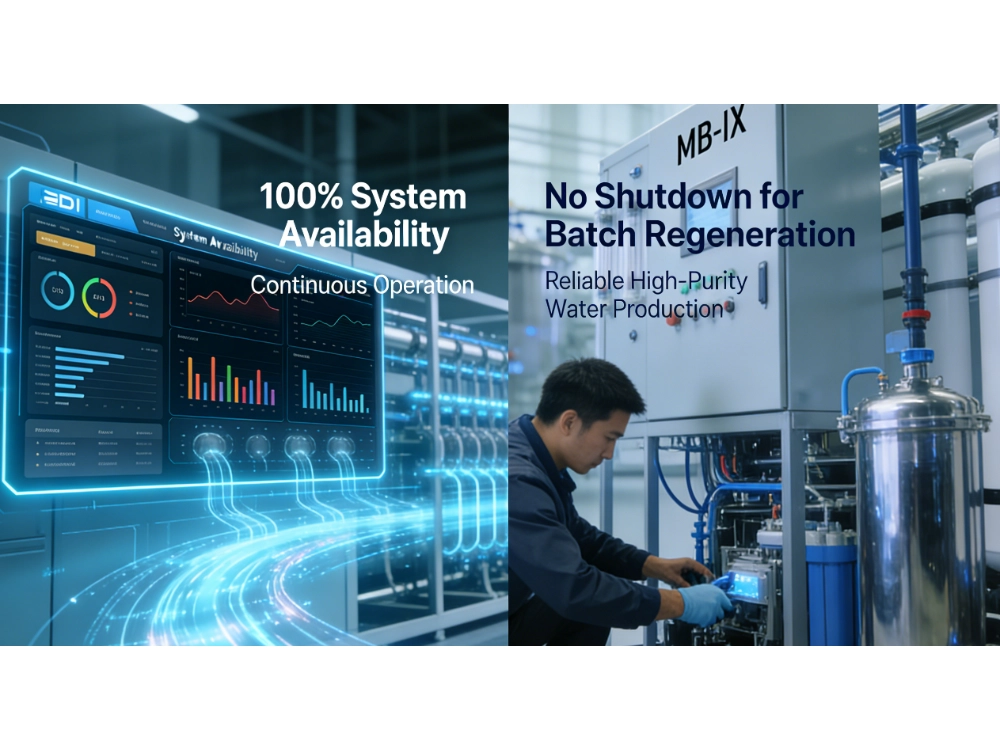
2. Durée de fonctionnement continu : Réaliser 100% Disponibilité du système
Le principe opérationnel de EDI permet par nature un fonctionnement continu, contrairement aux systèmes MB-IX, qui nécessitent une mise en œuvre complète. temps d'arrêt pour la régénération des lots. Des pannes, même brèves, peuvent entraîner énorme des pertes de production dans des secteurs industriels à forte demande comme les semi-conducteurs et les produits pharmaceutiques.
EDI offre de systèmes inégalé capacité de fonctionnement continu, garantissant 100% Le temps de fonctionnement du système et la production fiable d'une eau ultrapure de haute qualité par électrodéionisation sont ainsi réduits. Cela permet non seulement de réduire les coûts annuels d'entretien et de main-d'œuvre, mais aussi, et surtout, d'améliorer la qualité de l'eau. important, Il fournit aux clients absolu la fiabilité de la production - un élément essentiel de la percée de l'électrodéionisation.
3. Simplifier en a 4 étapes Processus : Réduire la dépendance à l'égard de la main-d'œuvre
Le niveau d'automatisation du système d'électrodéionisation est très élevé. supérieur à celle des systèmes IX conventionnels. Le fonctionnement traditionnel en lit mixte implique jusqu'à 40 ou plus des étapes complexes, notamment l'ajout de produits chimiques, le mélange, le lavage à contre-courant et le rinçage, ce qui exige une surveillance continue de la part de l'équipe d'experts. très expérimenté des opérateurs.
Le processus d'électrodéionisation est simplifié à des étapes de base : démarrage, surveillance, nettoyage occasionnel et arrêt. Ce processus massif La simplification offre plusieurs avantages clé avantages :
-
Réduit la dépendance à l'égard d'une main-d'œuvre hautement spécialisée.
-
Plus bas le risque d'erreur humaine (un majeur (qui est la cause de l'instabilité de la qualité de l'eau).
-
Économiser plus 40% de temps d'opération manuelle.
4. Prolonger la durée de vie des membranes d'osmose inverse en amont en 2X
Alors que l'électrodéionisation est une unité de polissage final, son rôle de protection du système d'osmose inverse (OI) en amont est le suivant cruciale.
L'électrodéionisation traite efficacement le perméat d'osmose inverse, ce qui nécessite généralement extrêmement faible la dureté de l'eau d'alimentation. Ce traitement secondaire efficace stabilise la qualité de l'eau. En outre, comme l'électrodéionisation fonctionne en continu et n'introduit pas de produits chimiques agressifs, le processus global de traitement de l'eau est plus stable. L'électrodéionisation est un procédé de traitement de l'eau plus stable. efficacement réduit les produits chimiques choc et l'encrassement des membranes d'osmose inverse en amont, facilement la réalisation plus de 2X la vie de la membrane standard. Il s'agit d'une essentiel coût à long terme avantage de l'utilisation de l'électrodéionisation.
5. Ultime Qualité : Résistance de sortie constante ≥ 18MΩ-cm
Les clients internationaux, en particulier dans le domaine de la fabrication de haute technologie, exigent exceptionnellement élevé la stabilité et la cohérence de la qualité de l'eau.
Dans les lits mixtes traditionnels, la qualité de l'eau peut baisse drastique lorsque la résine s'épuise vers la fin du cycle de régénération.
L'électrodéionisation permet absolument constant qualité de l'eau ultra-pure, avec une résistance atteignant typiquement 18 MΩ-cm ou plus. Il s'agit d'une inégalé la stabilité est le secret L'arme de l'Europe pour des industries telles que les produits pharmaceutiques, la microélectronique et la production d'énergie, afin d'atteindre les objectifs de l'Union européenne en matière de sécurité alimentaire. zéro défaut qualité du produit, ce qui fait de l'électrodéionisation le choix privilégié.
Choquant Données : 30% Réduction de la 5 ans Coût total de possession (TCO)
Lorsque les clients prennent des décisions en matière de marchés publics, ils se concentrent sur Coût total de possession (TCO), et pas seulement les dépenses initiales en capital (CapEx).
Bien que l'investissement initial dans un système d'électrodéionisation puisse être légèrement supérieur à celui d'un système d'électrolyse à IX, il n'en demeure pas moins que l'électrodéionisation est une solution efficace. 5 ans L'analyse du TCO montre qu'un écrasante avantage. En éliminant les produits chimiques, en réduisant la main d'œuvre, en diminuant la fréquence de la maintenance et en évitant les pertes de temps, le coût total de possession de l'électrodéionisation peut être de 30% inférieur que les systèmes IX.
Le secret réside dans les économies d'exploitation rapides de l'électrodéionisation, qui compensent rapidement l'investissement initial. particulièrement bénéfique pour des applications continues à grande échelle.
7. Conception modulaire : Rapide Déploiement et Flexible Mise à l'échelle
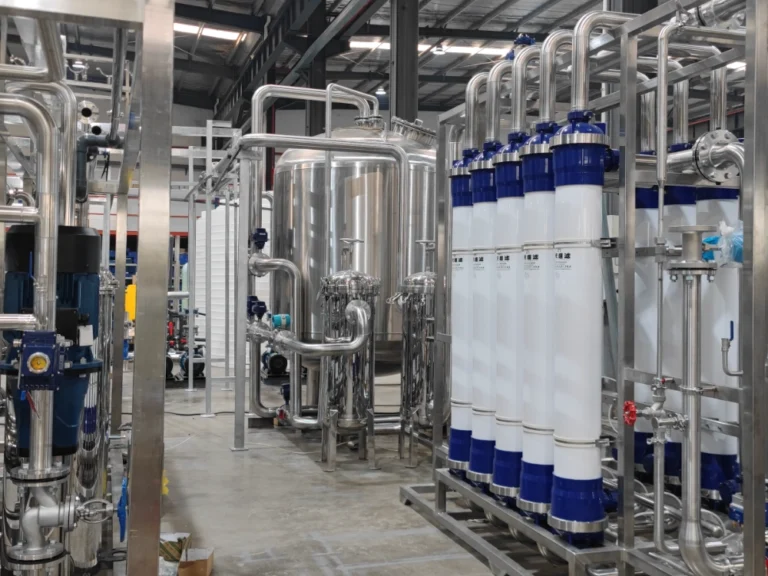
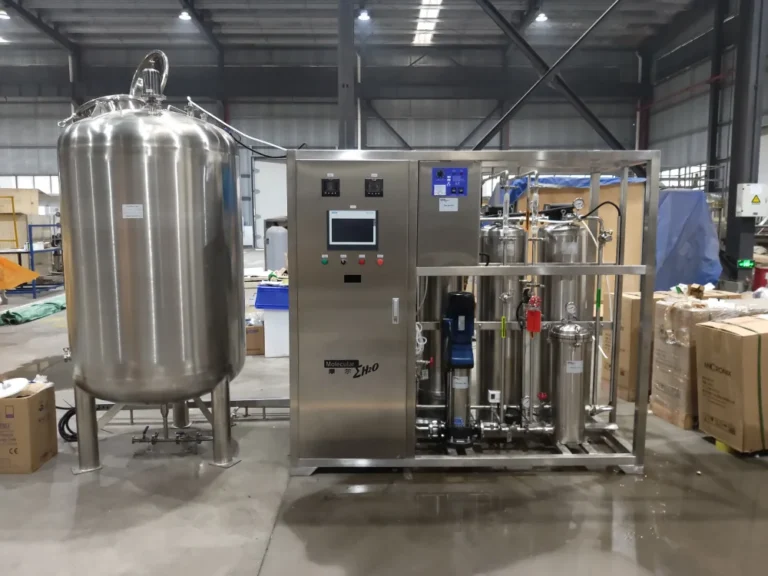
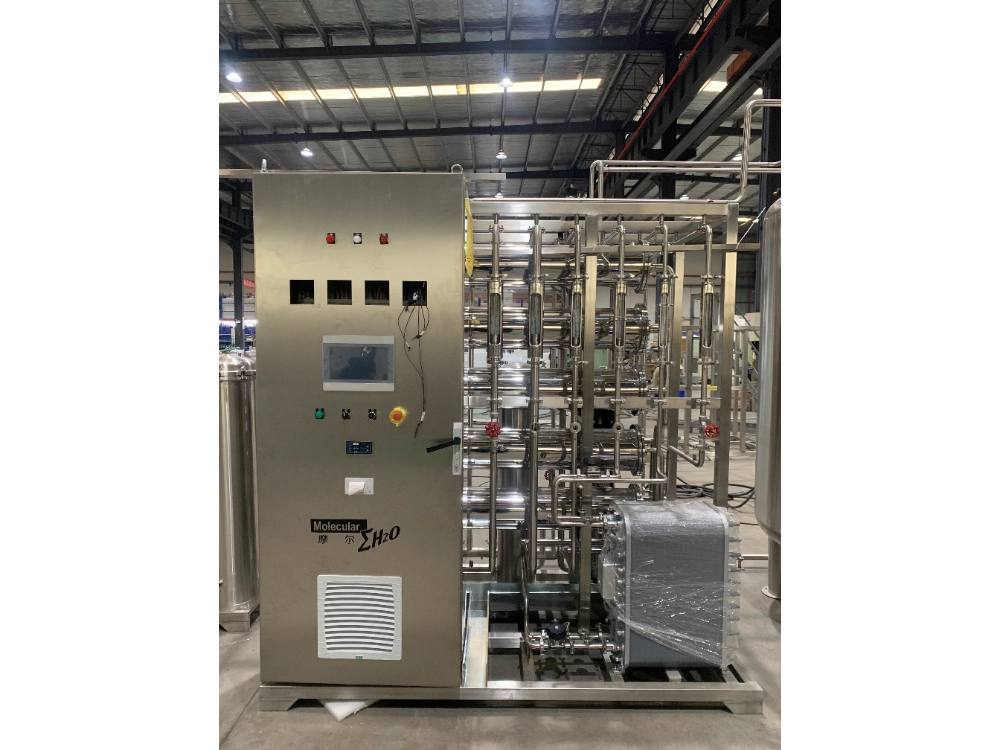
EDI Les modules sont généralement compacts, montés sur un skid ou sur un châssis. modulaire dessins.
Le transport, l'installation et la mise en service du système sont ainsi facilités. extrêmement rapide et pratique. Pour les projets à l'étranger nécessitant un démarrage rapide, cela permet d'économiser important le temps consacré à la construction et à l'intégration du site. En outre, si la capacité doit être augmentée à l'avenir, il suffit d'ajouter une autre unité de production. EDI Le module fournit une flexibilité inégalée. Cette modularité est une incontournable pour assurer la pérennité de votre investissement dans le traitement de l'eau.
Conclusion : Le temps de l'action EDI La transformation est Maintenant
En mettant en œuvre EDI votre entreprise peut rapidement réaliser réductions massives des coûts d'exploitation tout en garantissant absolument la stabilité de la qualité de l'eau et inégalé les avantages pour l'environnement. Ces derniers 7 secrets ultimes confirmer que EDI est le essentiel solution pour efficace, durable la croissance de l'industrie du traitement de l'eau.
Contactez-nous dès aujourd'hui pour personnaliser votre EDI et commencez à faire l'expérience de la énorme les avantages de broyage les coûts de régénération !